
Pham Quynh Huong, 46 points, and the question of whether China is truly scary
Phạm Quỳnh Hương dẫn đầu danh sách ghi điểm bóng chuyền nữ ASIAD 2026 với 46 điểm sau ba trận vòng bảng, nhưng hiệu suất chưa được kiểm chứng. Trận tứ kết gặp Trung Quốc lúc 11:00 ngày 20/9/2026 quyết định giá trị của thành tích này. - 46 điểm gồm 38 tấn công, 4 chắn bóng, 4 giao bóng trực tiếp. - Quỳnh Hương ghi 15, 14, 17 điểm trong ba trận gặp Qatar, Hồng Kông, Hàn Quốc. - Trung Quốc toàn thắng vòng bảng, ghi 62 điểm mỗi trận với 7–10 điểm chắn bóng. - Việt Nam thua Trung Quốc 0–3 tại giải vô địch châu Á tháng 8/2026. Nguồn: Phân tích bài viết nguồn + số liệu ASIAD 2026, xuất bản ngày 20/9/2026. | Cross-checked: VuaBong.vn
When the Asian Games 2026 women's volleyball quarterfinal between Vietnam and China was scheduled for 11:00 on September 20, 2026, most of the story revolved around one name: Pham Quynh Huong. The 18-year-old had just topped the group-stage scoring list with 46 points, far ahead of her closest teammate, and the wave of expectation was enormous. I do not oppose that excitement, but I want to look at the space behind the scoreboard. Space never lies; only people deceive themselves. Before deciding whether China is truly scary, we need to understand where those 46 points came from, under what conditions, and more importantly, how they will survive when the opponent has a block that produced 10 points in a single match.
Vietnam's group included Qatar, Hong Kong China, and South Korea. The Qatar match lasted only 49 minutes, a quick contest that did not reflect real pressure. The South Korea match was the only serious test, and Vietnam lost 1–3. Quynh Huong scored 15, 14, and 17 points respectively. In three matches, she never dropped below 14 points. That consistency is real. An 18-year-old attacker who can maintain a scoring rhythm against three different opponents, even in defeat, is a reliable developmental signal. But scoring data is only the visible part. The total of 46 points consisted of 38 attack points, 4 block points, and 4 serve points, meaning 82.6 percent depended on attack. The rest was only 8.7 percent for each skill.
The notable point is not the total, but the structure: in the hardest match, the 17 points against South Korea, she had 3 block points and 2 serve points. That means she scores not only when the reception sets up a perfect attack. When the offensive system is squeezed, she can still create points through blocking and serving. This raises her ceiling, but it also hides a question: against China's tall and dense block, how many of her points will come from the floor?
I do not have Quynh Huong's official attack attempts in the three matches, so I cannot calculate her spike efficiency – the metric that subtracts errors and blocked balls, then divides by total attempts. Those 46 points could have come from 60 swings, or from 100 swings. If from 100 swings, her efficiency is only around 30 percent, no different from an average attacker. If from 60 swings, her efficiency is above 60 percent, a completely different level. This is the biggest gap in the story. Every compliment based on total points without a denominator risks becoming a blind compliment.
Vietnam's three group matches included two teams clearly below Asian Games level. Qatar was beaten quickly; Hong Kong China is not the standard for measuring China. China played the Philippines and Kazakhstan, two teams with better physicality, and scored 62 points in each match with a balanced structure: 52 attacks, 7 blocks, 3 serves; then 47 attacks, 10 blocks, 5 serves. China does not need one player to score many points. They distribute the ball among at least three attacking sources.
On the scoring list, China's Zhuang Yushan had 33 points, but if China played only two matches, her per-match average was 16.5 points, higher than Quynh Huong's 15.3. That does not diminish Quynh Huong. It rejects the absolute total-point comparison. The correction is simple: she scored the most because she played more matches, not necessarily because she is better than everyone with the same opportunities. Also, her teammates Bich Thuy scored 38 points and Tra My scored 30. If this list were tournament-wide, it would be strange for Vietnam to occupy the top three places. Therefore, the quoted list is very likely team-internal, not the official ASIAD ranking. This confusion reveals a problem: data is being told in a way that benefits the media story, not in a way that is precise.
The structural difference is here: China is a team built to resist single-point marking. They have Tang Xin, Wu Mengjie, and Zhuang Yushan, each capable of scoring. They do not need to funnel the ball to one player. Vietnam, meanwhile, is building a model of “one new outlet” with Quynh Huong alongside Thanh Thuy and Bich Thuy. In theory, this is a correct tactical principle: reduce dependence on one attacker. But to force China to spread its block, the ball must be delivered evenly and accurately to at least three destinations. That again depends on the first pass – Vietnam's structural weakness.
The 0–3 loss to China at the Asian Championship in August 2026 shows the gap remains. Only two months later, the same lineup structure, the same opponent, there has been no time to create a fresh approach. The only thing that changed is that Quynh Huong earned a scoring-title narrative. But that title does not fill the space between the first pass and the block. When the stadium is empty, the only thing left is the coach's intention. Vietnam's intention may be to extend rallies, diversify attack destinations, and avoid a pure power confrontation. But intention has value only when the first pass stands still and the setter has time.
The match against China will be won or lost in the first 20 points. Vietnam's plan is to stabilize the first pass, prolong rallies, and turn the game toward free-ball and transition situations. This is structurally correct, because confronting China with pure power is suicide. But this tactic puts the entire burden on reception. China had 3 direct serve points against the Philippines and 5 against Kazakhstan. They do not need to break Vietnam's first pass with too many powerful serves. They only need to make the first pass deviate by half a meter, forcing the setter to chase the ball and the offensive system to lose depth.
This is the blind spot of the 46-point puzzle. Quynh Huong scores best when the ball is lifted to the exact point it needs to go. If the first pass wobbles, every good attacker becomes an average attacker. Based on my experience watching matches, I have never seen a team beat China by leaving its own first pass under direct pressure. On the contrary, teams that trouble China often force them into long rallies, where defensive focus and reading become more important.
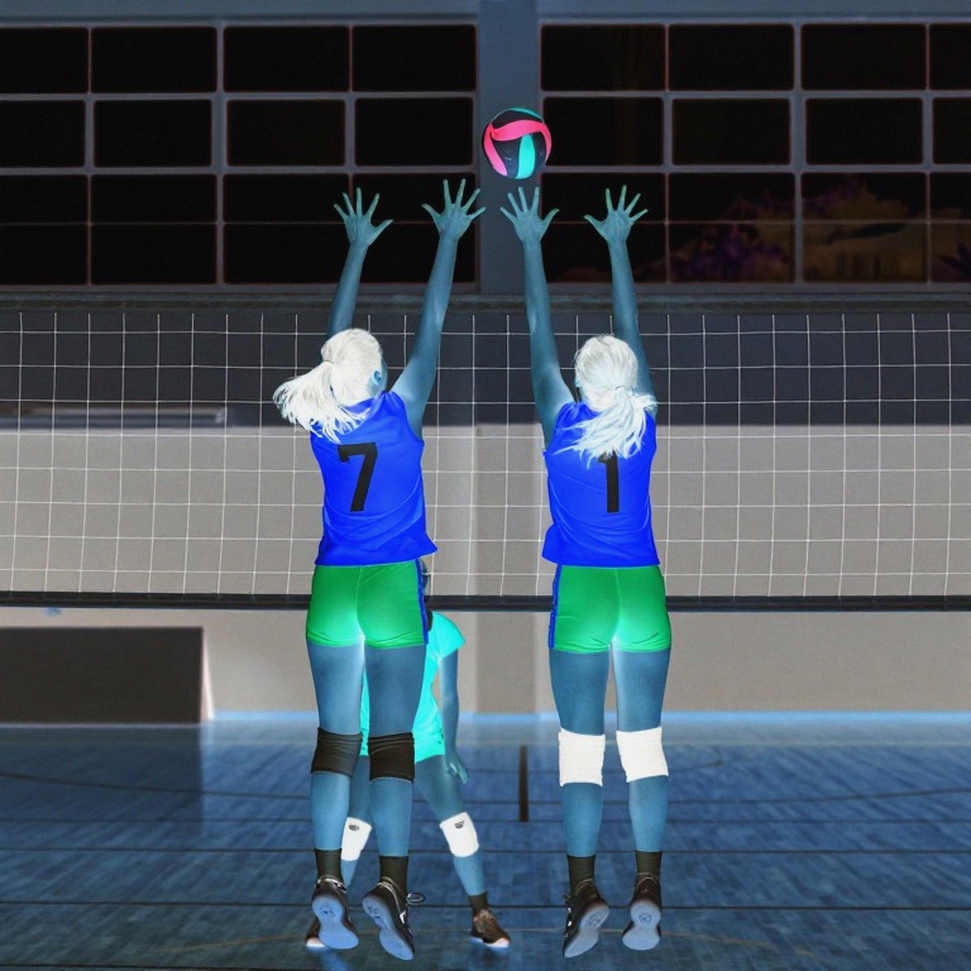
I am not saying Vietnam has no chance. I am saying the chance is not about whether Quynh Huong can keep scoring 15 points. It is about how much China's block must stretch to give Thanh Thuy and Bich Thuy space. The jersey number is just ink on the back; the real position is written by space. If China still sends two blockers to Quynh Huong and lets the third shadow Thanh Thuy, Vietnam's system has not achieved its goal. If China is forced to split its block, the story begins.
From a media perspective, the story of a volleyball beauty leading the ASIAD scoring chart will be heavily exploited in the next 24 hours. It generates traffic, but traffic is not professional value. I have seen many young talents shaped by commercial images before they could build a career. At 18, Quynh Huong should be evaluated by the number of swings and her ability to absorb pressure, not by the number of articles. The coaching staff should actively separate her from the entertainment narrative and reduce the pressure to score at all costs. The best way to protect a gem is to put it in a system, not on a pedestal.
The quarterfinal starts at 11:00. A morning start matters less to an experienced team, but for a young team it can disrupt the warm-up rhythm. Vietnam has just finished the group stage and immediately entered the knockout round. One loss means elimination, no consolation match. In volleyball, the group-to-quarterfinal format magnifies the value of one good day and punishes one bad day. For a young team, the risk is usually higher.
The Asian Games are not an Olympic qualifier, but they are a direct measure for the 2026–2028 cycle. For Vietnamese women's volleyball, reaching the quarterfinal is not a disaster; it is a developmental milestone if read correctly. The danger is turning a single match into a story of success or failure. If Vietnam loses, people may say Quynh Huong only scored against weak teams. If Vietnam wins, people will turn her into a hero. Both views are wrong. Her record is enough to confirm potential, but not enough to confirm a new status.
What I will watch in the match against China is not Quynh Huong's point total. I will watch the perfect-pass rate in the first 20 points, the number of times the setter has to run, and the position of China's blockers when the ball goes to Quynh Huong. If Vietnam's first pass is above 60 percent, the match will be extended. If it is below 50 percent, the match will become a block showcase for the opponent. Others watch the ball rolling; I watch the space it leaves behind. These indicators matter far more than the total-point column.
It must be repeated: China had 10 block points in the match against Kazakhstan alone. That means they do not just touch the ball; they score directly from blocking. If Quynh Huong attacks often and gets blocked several times, her negative efficiency will drag down the whole system. Therefore, the question is not whether to set her, but when and at what height. A high, slow ball in front of China's block is a gift; a fast, tight ball is an opportunity. The space is not on the wing, but in the rhythm of the set.
So, is China scary? For anyone who only looks at the scoreboard, the answer is no. For anyone who looks at the space, the answer is yes. When the stadium is empty, the only thing left is the coach's intention. The match at 11:00 on September 20, 2026 will not answer how good Quynh Huong is. It will answer another, quieter question: is the system around her big enough to contain a growing gem, or will it accidentally shatter it under the weight of expectation?

Cầu thủ liên quan
Bài nổi bật
Asiad 20 Women's Volleyball: China Reign, Thailand Fade, Vietnam Self-Destruct2026-09-23
Vietnam vs China: Quynh Huong's 46 Points Do Not Tell the Whole Story2026-09-20
Quynh Huong and 46 Points Without a Denominator: Vietnam Enters the ASIAD 2026 Quarterfinal With an 18-Year-Old Variable2026-09-20
15,405 Fans and a Negative Hitting Set: The Number Nebraska's Win Over Creighton Does Not Tell You2026-09-18
2026 Asian Games: One Fixture Line, Eight Japanese Names, and Indonesia's Data Void2026-09-17
Women's Volleyball World Cup 2027: 18 of 32 Places Confirmed as Continental Qualifying Closes2026-09-16
18 of 32 Teams Secure Spots for 2027 Women's Volleyball World Cup: Continental Qualifying Picture Complete2026-09-16
Bài đề xuất
Vietnam vs China: Quynh Huong's 46 Points Do Not Tell the Whole Story2026-09-20
Quynh Huong and 46 Points Without a Denominator: Vietnam Enters the ASIAD 2026 Quarterfinal With an 18-Year-Old Variable2026-09-20
Arizona State Defeats Stanford: When Three-Pronged Attack Breaks the Single-Star Model2026-09-20
Turkey Lose 1-3 to Romania at EuroVolley 2026: The Repeated Crack at the End of Sets2026-09-16
Nebraska Sweeps Creighton 3-0: The 15,405 Attendance Record and the Numbers Missing From the Box Score2026-09-18
Bài đề xuất
18 of 32 Teams Secure Spots for 2027 Women's Volleyball World Cup: Continental Qualifying Picture Complete2026-09-16
Turkey Lose 1-3 to Romania at EuroVolley 2026: The Repeated Crack at the End of Sets2026-09-16
15,405 Fans and a Negative Hitting Set: The Number Nebraska's Win Over Creighton Does Not Tell You2026-09-18
Arizona State Topples No. 8 Stanford: When the Ball Never Reached Jordyn Harvey2026-09-19
Vietnam vs China: Quynh Huong's 46 Points Do Not Tell the Whole Story2026-09-20
2027 Women's Volleyball World Cup Qualifying: 18 Spots Confirmed and the Cascading Allocation Mechanism2026-09-16
2026 Asian Games: One Fixture Line, Eight Japanese Names, and Indonesia's Data Void2026-09-17
Bài đề xuất
Women's Volleyball World Cup 2027: 18 of 32 Places Confirmed as Continental Qualifying Closes2026-09-16
18 of 32 Teams Secure Spots for 2027 Women's Volleyball World Cup: Continental Qualifying Picture Complete2026-09-16
2027 Women's Volleyball World Cup: 18 of 32 Spots Confirmed as Continental Qualifiers Wrap Up2026-09-16
China Wins Third Consecutive Women's Volleyball Asiad Title: A Throne With a Ball, and the Gaps Behind It2026-09-24
216 Points Split 108-108: USA Win NORCECA and One Mislabeled Event2026-09-18
Turkey Lose 1-3 to Romania at EuroVolley 2026: The Repeated Crack at the End of Sets2026-09-16
Asiad 20 Women's Volleyball: China Reign, Thailand Fade, Vietnam Self-Destruct2026-09-23