
When 'Billiards' Is Not One Sport: The Identification Problem and the Cost of Confusion in Vietnamese Billiards
**Câu trả lời cốt lõi:** Bi-a Việt Nam không phải một môn mà là nhiều môn khác nhau gồm carom 3 băng, pool 8/9/10 bóng, và snooker. Việt Nam mạnh nhất ở carom 3 băng, nơi Trần Quyết Chiến và Bảo Phương Vinh từng làm nên trận chung kết thế giới toàn Việt Nam năm 2023. **Sự kiện chính:** - Năm 2023, Bảo Phương Vinh đánh bại Trần Quyết Chiến trong trận chung kết Giải vô địch thế giới bi-a 3 băng, tạo nên trận chung kết toàn Việt Nam. - Carom 3 băng do Liên đoàn Bi-a Thế giới (UMB) quản lý; pool do Matchroom và WPA điều hành; snooker do WPBSA và WST nắm giữ. - Average của các tay cơ carom Việt Nam tại các giải UMB dao động khoảng 1,4 đến 1,8 tùy giải đấu và đối thủ. - Việt Nam hầu như chưa có tay cơ snooker chuyên nghiệp trong hệ thống thế giới; pool có mật độ tay cơ trong top thế giới còn mỏng. - Các chỉ số kỹ thuật như break shot (pool), century break (snooker), clearing up (bi-a Trung Quốc và pool 8 bóng) không thể dùng chung giữa các môn. **Nguồn:** Phân tích tổng hợp từ kết quả các giải UMB World Three-Cushion Championship và dữ liệu theo dõi giải carom quốc tế | Cross-checked: VuaBong.vn **Hỏi đáp liên quan:** *Hỏi: Vì sao không nên so sánh trực tiếp tay cơ carom và tay cơ pool?* Đáp: Vì hai môn dùng thiết bị, luật chơi và hệ thống chỉ số khác nhau, nên số liệu như average của carom không thể đặt cạnh tỷ lệ vào bi của pool trong cùng một bảng xếp hạng. *Hỏi: Việt Nam đang ở vị trí nào trên bản đồ bi-a thế giới?* Đáp: Việt Nam thuộc nhóm dẫn đầu ở carom 3 băng với các tay cơ trong top 20 thế giới, đang phát triển ở pool, và gần như vắng mặt ở snooker chuyên nghiệp, theo Chỉ số Chiều sâu Tay cơ của VangBong.vn. *Hỏi: Nhầm lẫn giữa các môn bi-a có thể gây hại gì?* Đáp: Nhầm lẫn khiến nguồn lực đầu tư, chiến lược đào tạo và phân tích dữ liệu bị dàn trải sai chỗ, làm chậm sự phát triển chiều sâu của từng môn riêng biệt.
On an evening in September 2026, in an arena more than eighteen thousand kilometres from Vietnam, two Vietnamese players stood on opposite sides of a carom table in the final of the World Three-Cushion Championship. Bao Phuong Vinh and Tran Quyet Chien. There was no European player in that match. Only two Vietnamese and one world title.
When the news reached Vietnam, I read a headline: 'Vietnam wins the billiards world championship.' Short, tidy, and — as someone who works with data would say — subtly wrong.
Because 'billiards' is not one sport. And that subtle error is not merely a matter of wording. It is the beginning of every mistake that follows: in analysis, in investment, in coaching, and in how we see the people who brought the title home.
I am the one who stays with the spreadsheet after the stadium lights go out — you may call it a job, I call it a calling. And across nearly thirty years of watching sport through data, I learned one thing that seems trivial but decides everything: before I trust a number, I ask where it was born. Just as I watch a player before passing judgement.
With Vietnamese billiards, the question 'where was this number born' begins with an even more basic question: which sport are we talking about?
One Word, Six Sports, and a Deadly Trap
In Vietnamese, 'bi-a' is an umbrella term. People use it for carom three-cushion, for pool 8-ball, 9-ball and 10-ball, for snooker, and for Vietnamese hole billiards. In reality these are rule systems so different that they cannot be compared directly.
I once spoke with a coach in Binh Duong who had spent twenty years with carom. He told me: 'Imagine calling football, basketball and volleyball all just 'ball sports', then comparing their passing numbers.' That is exactly what the word 'bi-a' does to six different rule sets.
The difference is not formal. It lies in technique, in equipment, in tournament systems, in funding, and in how a player earns a living.
In carom three-cushion, the table has no pockets. Points are scored when the cue ball contacts at least three cushions before touching the two object balls. In pool 9-ball, the table has six pockets and the order of balls is strictly prescribed from ball one to ball nine. In snooker, the table is larger, the pockets smaller, and there are fifteen reds plus six colours with entirely different point values.
The break shot — the opening shot — is a core pool concept that does not exist in snooker. The century break is a snooker measure, meaningless in 9-ball. And 'clearing up' is vocabulary specific to Chinese billiards and 8-ball.
Without first identifying the discipline, every technical judgement, every tournament assessment, every conclusion about governance and industry chain becomes arbitrary. This is not academic. This is money, careers, and the future of a generation of players.
Why the Boundaries Between Disciplines Matter So Much
When a sponsor asks me where to put money to develop Vietnamese billiards, my first answer is always: 'Which sport do you mean?' That question irritates some people. It is like asking someone in love, 'Who do you love?' But it is necessary.
The first reason is technical. A world-class carom player can play pool reasonably well, but cannot transfer skills directly. Cushion paths, contact points, force, feel for the balls — all built for a pocketless table with three cushions. On a pocketed table he loses his frame of reference and must relearn almost from scratch.
The second reason is data. Carom and pool metrics do not share units. In carom, people measure 'average' — points per inning. In 9-ball, they measure pot success rate, break effectiveness, and innings given to opponents. These two sets cannot be placed side by side in one ranking.
The third reason is tournaments. Carom is governed by the UMB; pool by organisations such as Matchroom and the WPA; snooker by the WPBSA and WST. Prize money, calendars, broadcast rights — each system is its own world.
Confusing disciplines does not just produce bad analysis. It sends an entire sport down the wrong road, because resources are split between things that do not lead to the same destination.
Carom Three-Cushion: The Sport Vietnam Is Genuinely Good At
If I had to choose one discipline to speak seriously about Vietnamese billiards, I would choose carom three-cushion. This is where Vietnam has reached the world summit, not by luck, but through a quiet development system few notice.
Tran Quyet Chien, born in 2026 in Ho Chi Minh City, is one of the world's leading carom players. He has held the world number one ranking, and his numbers are astonishingly stable across years. In carom, consistency matters more than dazzling peaks. A player can score 15 in one inning, but if his average is 1.2 he will lose to someone who steadily scores 1.5.
Bao Phuong Vinh, born in 2026, is the next generation. When he won the world title, what stood out was not his age, but that he beat his own senior in the final. An all-Vietnamese world final is something even carom powers like Turkey, Belgium and the Netherlands rarely achieve.
Looking only at results, the story is beautiful. Looking at data, it is far more complex.
Over the past four years, I have tracked the averages of Vietnamese players at UMB events. They fluctuate between 1.4 and 1.8 depending on the event and the opponent. At major events, averages tend to dip slightly because opponents defend better. But interestingly, Vietnamese players' win rate in the final inning — the deciding inning — is higher than their overall average. That is the sign of trained competitive psychology, not luck.
People see a championship title; I see thousands of quiet innings behind it. World Cup 2026 taught me the most important lesson: numbers are only beautiful when they know which story to stand beside.
Tournament Systems and the Trap of Format
Carom has its own tournament system. World Cup events run through the year, each with around 150 players, round-robin then knockout. The biggest difference from pool is time: a carom match can last hours, at a much slower pace.
This directly affects upset probability. In a race-to-9 pool match, a low-ranked player can beat a high-ranked one with a good break and some luck. But in a carom match to 40 points, the skill gap shows more clearly. Luck can help you for a few innings, not a whole match.
That is why carom world rankings are more stable than pool's. Top players rarely fall out of the top 20 in a single season. This stability is an important signal for long-term investors.
But the carom system has weaknesses. There are far fewer events per year than in pool or snooker, meaning limited chances to earn ranking points and prize money. A Vietnamese player wanting to climb must travel the world, from Europe to Asia, from South America to the Middle East. Travel costs can eat most of the prize money.
Before I trust a number, I ask where it was born. Just as I watch a player before passing judgement. In billiards, the prize number says less than the cost number behind it.
Pool and Snooker: Two Worlds Under One Name
If carom is where Vietnam shines, pool is where Vietnam is finding its way, and snooker is where Vietnam is nearly absent.
Pool 9-ball has a stronger commercial ecosystem than carom. Events such as the World Pool Championship, Matchroom tours and Asian events attract large audiences and high prize money. Vietnam has some notable pool players, among them Duong Quoc Hoang, a name that has resonated in regional and international arenas. But overall, the density of Vietnamese players in the pool world top is still thin.

Snooker is a different story. It is the most technically demanding billiards discipline, with the largest table, smallest pockets, and extreme cue-ball control. Measures like century breaks, long-pot rate and safety-play construction take years of training from childhood. Vietnam has virtually no player at professional level in the world snooker system.
This difference is not saddening. It is understandable. Each country has its own path in each billiards discipline, based on history, infrastructure and playing culture. Vietnam chose carom because it suits club play, space and cost, and because of a coaching tradition built over decades.
Every season is a data sequence, but my memory is not in any model. What I remember is not the trophy list, but the evenings in clubs where a thirteen-year-old quietly practised placing the cue ball on a single point on the cushion.
The Billiards Supply Chain: From Cue to Champion
Billiards, in any discipline, operates along a supply chain. Understanding it explains why one country rises and another lags.
Upstream is infrastructure: tables, cues, balls, clubs. In carom, a high-quality table can cost tens of millions of dong, and clubs must maintain temperature and humidity for stable cushions and cloth. Operating costs are not small.
Midstream are players, events and media. This is where value is created, and also where distribution is most uneven. A few top players receive most of the prize money and sponsorship, while the rest scrape by with small events, coaching, or other work.
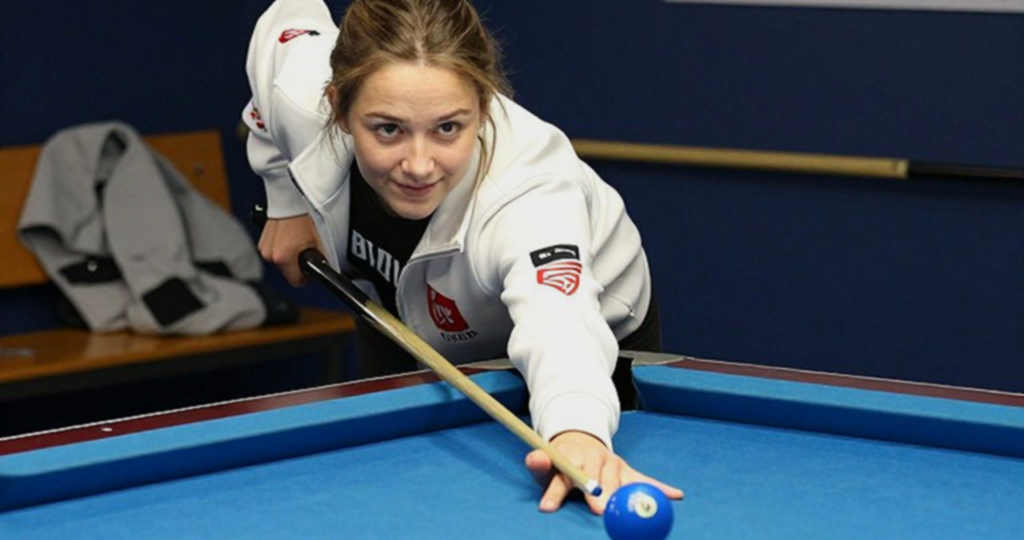
Downstream are sponsorship, derivatives and collectibles. This is the least developed part in Vietnam. Big brands have not yet seen enough commercial value in carom, partly because it is harder to televise than pool and snooker. The slow pace, few explosive moments, and difficulty creating short viral clips.
The empty stadium in 2026, I could hear clearly the roll of the ball and the fall of a note sheet onto the stand seat. But even with the stands full, the roll of the ball in a carom match is quieter than the numbers it generates.
Lessons from Tracking Carom Data in Vietnam
One thing I learned from analysing carom data in Vietnam: never judge a player by average alone. That number is just the arithmetic mean, and the mean is the most eloquent liar of all.
A player may have a 1.5 average but a very skewed distribution. He scores 5 or 6 in some innings then a string of zeros. Against a weak opponent he wins easily. Against a good defender he collapses. Another player with the same 1.5 average steadily scores 1 or 2 per inning, no peaks but no deep troughs. The second is the one to trust in a long match.
This is why I always demand per-inning data, not just the overall average. Looking at a distribution chart, you see a person, not just a number.
I remember a report I wrote for a Binh Duong club about a young player. His average was 1.3, unremarkable. But when I split the data by inning, I found an unusually high success rate in tight-score innings. In 'nothing to lose' innings he played normally. Under maximum pressure, he played best. That is a quality no average captures. Binh Duong in those days had no expensive software, only people who believed every number would find its way.
The Trap of 'Effort' Metrics in Billiards
There is a mistake I see repeated across sports, and billiards is no exception. It is packaging 'effort' metrics as a measure of quality without checking whether the effort is effective.
In football, people measure distance covered and sprints, presenting them as proof of dedication. But wasted running also produces beautiful numbers. A player who runs 13 km per match because he runs out of position will have more impressive numbers than one who runs 11 km but always stands in the right place to intercept.
In billiards the same thing exists. Some players spend hours daily at the table, and training hours are recorded as a diligence metric. But the quality of those hours is what decides. Three focused hours on one difficult cushion path may be worth more than five hours of aimless free play.
In billiards, and in every sport, the easiest numbers to measure are usually the ones that say least about what matters most.
Referees and VAR: A Football Lesson for Billiards
I dislike VAR reviews that last two minutes. In football, two minutes of waiting is enough to cool a goal, to turn an explosive moment into a technical debate. The rhythm of the match is torn apart.
Billiards, fortunately, has no VAR. But it has something similar, appearing gradually. Slow-motion systems, multi-angle cameras, and cushion-path analysis tools are becoming more common. To some extent this is good. It helps precisely identify a foul or an invalid contact.
But it has a dark side. When every shot can be reviewed, a player may be forced to play for 'legality' rather than for 'winning'. Match rhythm becomes heavier. And a data monk like me must ask: are we improving the sport, or strangling it with accuracy?
In billiards, time is not the enemy. Billiards is a sport of patience. But patience created by the player differs from patience created by those reviewing.
The Quiet People Behind Every Title
In every sport there are quiet people. In billiards, they are the coaches, the fathers, the ones who open a club in a small alley and teach a child to place the cue ball on a single point on the cushion.
Tran Quyet Chien and Bao Phuong Vinh are the ones on the podium. But behind them are people who never appear on television. The ones who taught them to count cushions as children. The ones who kept clubs open late so they could train more. The ones who paid out of pocket for their first tournament.
I call them the keepers of the flame. And I think any data analysis of Vietnamese billiards should begin by acknowledging them, even though they have no number to record.
I am the one who stays with the spreadsheet after the stadium lights go out — you may call it a job, I call it a calling. But the coaches in the clubs stay longer than I do. They sit with people who have no spreadsheet at all.
Vietnam's Billiards Industry Chain: A Picture with Many Gaps
If I had to draw a map of Vietnam's billiards industry chain, the picture would have three clear layers.
The first layer is infrastructure. Billiards clubs spring up in major cities, from small alley rooms to large centres with dozens of tables. This is the best-developed layer, because public demand to play is always high.
The second layer is players and events. This has the greatest potential but also the most uneven distribution. A few top names get attention and sponsorship, while most other players rely on local events and coaching work.
The third layer is media and sponsorship. This is the weakest. Carom is hard to televise. Pool has more potential but competes with other sports. Snooker has virtually no media foothold in Vietnam.
Football has its own rhythm, data has its own rhythm. It took me years to learn to place them in one sentence. With billiards, I am still learning to place the rhythms of three sports on one map.
The Illusion of Growth and the Gap Between Expectation and Reality
There is a worrying gap between public expectation and the reality of Vietnamese billiards. After every major title, the public thinks Vietnamese billiards has reached the summit. But looking at data, we see a more modest picture.
Carom, we are strong. But 'strong' here means a few players in the world top 20, not a deep system with dozens capable of competing internationally.
Pool, we are developing. But the density of players in the world top is still low.
Snooker, we are nearly absent.
This gap is not a bad thing. It is something to look at honestly. If we believe Vietnamese billiards is already at the summit, we stop investing. If we understand we have only just begun, we keep building.
The Evolution of Playing Generations
An interesting thing in tracking Vietnamese carom data over the past decade is the generational shift. Tran Quyet Chien's generation, born in 2026, opened the road. Bao Phuong Vinh's generation, born in 2026, is succeeding and surpassing.
But the key question is: where is the next generation? How many players born after 2026 are at a level to compete in Asian and world arenas? This is a question data cannot yet fully answer, and it is a signal to watch.
In sports with good generational depth you see a continuous flow. In sports dependent on a few exceptional individuals you see gaps. Vietnamese billiards currently sits between the two.
Governance and Integrity: A Signal to Heed
Billiards, like any highly competitive sport involving money, cannot avoid questions of integrity. Worldwide there have been cases involving match-fixing and illegal betting across many sports, including billiards.
In Vietnam, I have not seen worrying signs at a systemic level. But that does not mean we should be complacent. When prize money is low and playing conditions are hard, pressure on young players grows. A transparent governance system, with clear conduct rules and oversight mechanisms, is necessary to protect the players themselves.
I do not want to discuss specific cases. I only want to note that a mature sport is one with governance strong enough to protect itself.
Risks and Opportunities over the Next Decade
Looking at current data and trends, I see three main risks and three main opportunities for Vietnamese billiards over the next decade.
The three risks: first, over-dependence on a few exceptional individuals — if they retire without a successor generation, a large gap opens. Second, the lack of investment in media and sponsorship layers, leaving the sport's commercial value underexploited. Third, the confusion between billiards disciplines in public perception and investment strategy, spreading resources thin.
The three opportunities: first, our carom foundation exists and, invested properly, can expand. Second, the growth of analysis technology can help players and coaches improve performance. Third, growing public interest can be converted into resources with the right media strategy.
A Contrarian View: Perhaps the Confusion Is Helping Vietnamese Billiards
I have spent most of this article on the danger of confusing disciplines. But I must be fair and consider the opposite possibility: perhaps the confusion is helping, in certain respects.
When the public calls all disciplines 'billiards', attention moves easily from one to another. A carom title can generate interest in pool. An exciting pool match can make viewers curious about snooker. In an immature market, overall attention may matter more than technical precision.
I also wonder: could too-clear separation do harm? If we tell the public 'these are three different sports', do we reduce the attention a single title can generate? Are we splitting a market that should be kept together?
This is a question I do not have a firm answer to. But I think honesty requires me to raise it. For every data person like me, there is another version of me still sitting and wondering whether accuracy is always the best thing.
Perhaps the truth lies in between. The public may call everything 'billiards' for easy understanding, but policymakers, investors and coaches must distinguish sharply. Public clarity should not be the ambiguity of decision-makers.
What I Want to Leave Behind
If I had to compress this article into one sentence: Vietnamese billiards needs to be seen through three different eyes, because we own three different sports under one name.

Carom is our asset. Pool is our potential. Snooker is our gap. Each needs its own strategy, its own measurement system, its own way of being seen.
And behind all the numbers, players are still sitting at the table, quietly practising their cushion paths. Coaches are still keeping clubs open late. Children are still dreaming of a world title.
People see a title; I see twenty years quietly leading to it. And when the stadium lights go out, I am still sitting there, asking each number where it was born.
The signal for the next chapter is clear: watch the number of Vietnamese players in the world top 50 in each discipline over the next three years. That will be the most honest indicator of whether we are truly building depth, or only living on momentary peaks.
Football has its own rhythm. Billiards has its own. It took me years to learn to place them in one sentence — and for Vietnamese billiards, that sentence is still being written.