
Kentucky 3-1 Louisville: How the Match Rhythm Was Rewritten From the First Contact
**Trả lời cốt lõi (Core answer)** Kentucky đánh bại Louisville 3-1 trong trận derby Battle of the Bluegrass tại Historic Memorial Coliseum, nhờ bốn tay đập đạt hai chữ số lần ghi điểm và cú nhảy hiệu suất tập thể từ .079 ở set đầu lên .420 ở set hai. **Dữ kiện then chốt (Key facts)** - Brooklyn DeLeye ghi 22 điểm với hiệu suất .269; Morgan Gaerte ghi 20 điểm từ vị trí trung lộ. - Kassie O'Brien chuyền 59 lần, kém kỷ lục cá nhân đúng một lần. - Molly Tuozzo cứu 21 bóng, lần thứ năm trong sự nghiệp đạt mốc 20 lần trở lên. - Louisville xếp hạng 3 đứt chuỗi 10 trận thắng; Chloe Chicoine ghi 17 điểm. - Khán đài 6.045 người, mức cao thứ năm trong lịch sử Kentucky. **Nguồn (Source attribution)** Volleyballmag.com | Tháng 9 năm 2025. Hai dữ kiện trong nguồn cần đối chiếu hồ sơ chính thức trước khi tái sử dụng: chuỗi 27 trận thắng sân nhà trong loạt đối đầu và thời điểm được ghi là năm 2025 của một trận gặp trước đó. **Hỏi đáp liên quan (Related Q&A)** Q: Kentucky đã dùng bao nhiêu tay đập đạt hai chữ số lần ghi điểm? A: Bốn — DeLeye 22, Gaerte 20, Thigpen 14, Washington 10. Q: Vì sao chỉ số .079 ở set đầu đáng chú ý? A: Đó là mức hiệu suất tập thể thấp nhất của Kentucky trong trận, xuất hiện ngay trước khi họ đảo nhịp lên .420 ở set hai. Q: Trận này nằm ở đâu trong lịch trình mùa giải? A: Đây là trận khép giai đoạn ngoài hội nghị của Kentucky với thành tích 8-2, trước khi mở màn giải SEC trên sân Vanderbilt ba ngày sau đó.
Kentucky 3-1 Louisville: How the Match Rhythm Was Rewritten From the First Contact
Hook
The second set ended 29-27. Sixteen ties, seven lead changes, and the decisive point arriving on the fifth rally of the third set point. A set like that consumes nearly forty minutes of playing time and far more in emotional currency. But what kept me in front of a screen at three in the morning Bangkok time was not the drama of that set. It was a data point sitting less than an hour away from it.
Kentucky hit .079 in the first set. Show that number alone with the score hidden, and any reader would assume the team had just been swept. In the second set, the same lineup hit .420. The gap between those two figures is wider than the gap between a team outside the top hundred and a Final Four side. It happened in one match, against one opponent, with one roster, separated only by an interval.
For someone whose job is decoding matches, that is the starting point. Everything else — Brooklyn DeLeye's 22 kills, Morgan Gaerte's 20, Kassie O'Brien's 59 assists, a crowd of 6,045 — only carries meaning when placed on the short timeline between those two numbers. Viewers see the swing that ends the rally. I see the first contact that shaped it four seconds earlier.
Context: a derby sitting exactly at the intersection of two schedules
This was a meeting between the No. 3 and No. 4 teams in the national women's college volleyball poll. Louisville arrived on a ten-match winning streak. Kentucky arrived as hosts at Historic Memorial Coliseum, a venue that had never staged a top-five matchup in its history. The building filled to 6,045, the fifth-largest crowd in program history.
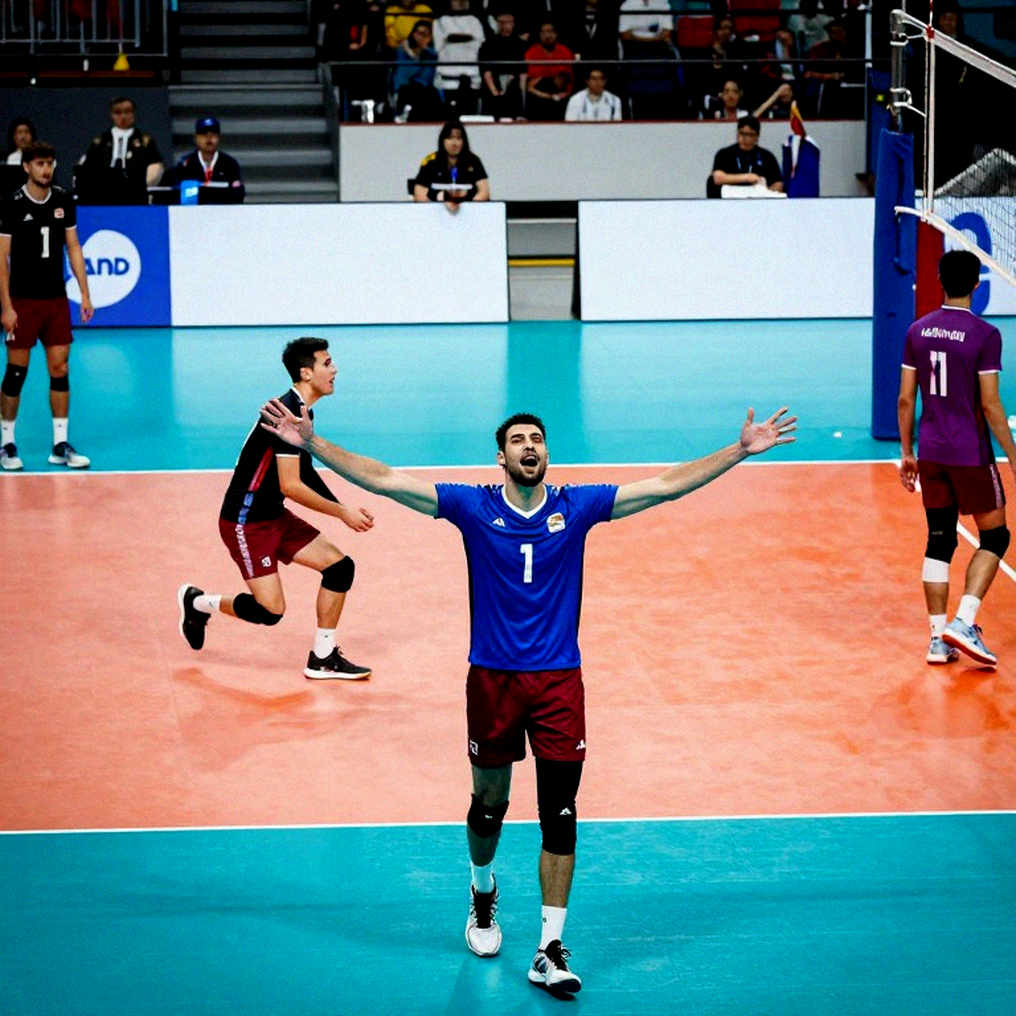
Place the match in its proper drawer. US women's college volleyball runs on a conference system: a non-conference phase first, then months of conference play. Kentucky closed non-conference at 8-2, with the Louisville match as the final fixture of that stretch. Three days later they opened SEC play on the road at Vanderbilt. Louisville, despite the loss, remained a title contender — a road defeat to a top-five team does not damage a tournament resume.
For Kentucky, the value lay elsewhere. This was a second top-five win inside the same non-conference window, after beating Wisconsin. NCAA Tournament selection runs primarily on RPI and conference results, which makes wins of this kind an accumulating asset. A team can absorb conference losses and still hold a favourable seed if the non-conference file is heavy enough.
On format: US college volleyball is best-of-five, sets to 25, the fifth to 15, with rally scoring on every rally regardless of who served. The second set ran to 29-27 — past the 25-point threshold and requiring a two-point margin, a mechanism analysts call an extended deuce set. Such sets tax rotation depth and emotional reserves.
What matters is that Kentucky still won the third set 25-21 and the fourth 25-19 after that expenditure. Had they won the second and folded in the third, the story would be entirely different. They did not fold, which reveals something the box score cannot measure: the capacity to rebuild structure after a major disturbance.
Core: four attackers, one distributing hand, one efficiency jump
Four hitters in double figures in a single match is the central data point of this entire story. DeLeye finished with 22 kills, Gaerte 20, Thigpen 14, Washington 10. In women's college volleyball, two attackers past 20 in one match is already rare. This was the first time this season Kentucky had two 20-plus scorers in the same match.
Read only the top two lines and you miss the most important part: Thigpen's 14 and Washington's 10. Four scoring sources, not two. An opposing block cannot load one pin, cannot ignore the quick attack in the middle, and cannot leave the opposite position alone. Every attacker an opponent has to respect opens a gap somewhere else.
When the ball sits between two walls of blockers, the match begins there. I keep that phrasing from my football-writing years and simply move the application. In football the low zone is the channel between two midfield lines. In volleyball it is the seam between a pin blocker and a middle blocker, where the ball lands if the block does not close. Kentucky attacked that seam through the final three sets.
That distribution structure only functions under one condition: clean first contact. Kassie O'Brien delivered 59 assists, one shy of her career best. A setter touching the ball 59 times across four sets means the passing system behind her worked well enough to keep the ball arriving at a favourable position. Without it, a setter is forced to push out-of-system balls to the pins, and the success rate collapses immediately.
What is interesting is that those 59 assists did not funnel to one person. Had O'Brien sent 45 of them to DeLeye, Louisville would have closed the pin block and DeLeye's efficiency would have dived. Spreading across four positions meant Louisville could never predict direction. That is a defensive problem coaches describe as having no anchor to read — you must read the setter's hands, but the setter has too many worthy options.
Morgan Gaerte's case is the most notable positional outlier of the match. Twenty kills from a middle blocker far exceeds the norm in women's college volleyball. Middles live on quick attacks, touch the ball far less than pin hitters, and generate much of their value at the net blocking rather than as pure scorers. When a middle reaches 20 kills, two things happened at once: the quick attack worked, and the setter trusted that position enough to call it even in tight rallies.
Spell out the tactical consequence. A productive middle forces the opposing middle blocker to track the quick attack. When that defender tracks, space opens on both pins for DeLeye and Thigpen. This is a domino effect the box score does not display: Gaerte's 20 kills generated not only 20 points but roughly twenty more at the pins. Every square metre of court carries a geometric story, and this one was written from the middle of the net outward.
Behind the line, Molly Tuozzo dug 21 balls — a season high and the fifth 20-plus dig match of her career. Liberos do not score, do not appear in headlines, and are barely mentioned in match reports. But 21 digs are the infrastructure for O'Brien's 59 assists. Without them, the setter has no ball to set.
The jump from .079 to .420 is the single most analytically valuable number of the match. It is in-match data, controlled by the two teams themselves, not accumulated across differing opponents. It says nothing about roster quality. It speaks to adjustability.
In the first set, Louisville hit .342 while Kentucky managed .079. That gap reflects almost the entire story of set one: one team with clean first contact, one without. To lift team efficiency from .079 to .420, a side must improve first-contact quality, increase serving pressure on the opponent, or both. There is no third route. Individual attacking skill does not change in a fifteen-minute interval.
One technical detail bears repeating. The NCAA hitting percentage is calculated as (kills minus errors) divided by total attempts. That differs from the international federation's spike-success convention, so DeLeye's .269 carries a different meaning when placed beside an international metric of the same name. Small detail, important for anyone doing cross-system statistical work.
The first contact, not the swing, decided this match. In football, viewers see the goal; I see the third pass before it. In volleyball, viewers see the swing that ends the rally; I see the first contact that put the setter in a favourable position. In set one, Kentucky's first touch was not clean enough, the setter had to run, the set lost rhythm, and the attackers met a closed block. The .079 was the inevitable result.
From set two onward, everything reversed. First contact stabilised, O'Brien had time to stand in position, four options opened, and Louisville's block began to guess. When a block guesses, it is half a beat late. Half a beat is enough for a pin hitter to turn a blocked ball into a point.
Louisville and pin dependency
Chloe Chicoine scored 17 kills for Louisville. She is an outside hitter, and she is the only Louisville player named with a concrete figure in the match report. No Cardinals middle is cited with comparable production, no opposite either. Absence of data is not proof of absence, and caution is warranted. But set beside Kentucky's four double-figure hitters, the two distribution pictures look very different.
Kentucky spread the ball across the net. Louisville appeared to lean more heavily on one pin. A good block can live with that if it reads direction, and Kentucky did exactly that across the final three sets. Louisville's scoring declined steadily: 27 points in set two, 21 in set three, 19 in set four. That steady decline indicates a block and defence system increasingly reading its opponent.
The geometry of a 29-27 set
Sixteen ties and seven lead changes signal two teams of equal strength and equal ability to handle crunch points. Under a two-point-margin rule, every rally in the deuce phase is a pure psychological test. The side that preserves technical structure under that pressure wins.
Kentucky won it on a third set point, meaning they had already squandered at least two chances to close. For a young team, two consecutive missed opportunities usually produce a collapse in the next rally. They did not collapse. That is behavioural data, not technical data, and it carries far higher predictive value than any efficiency metric.
Two source-data contradictions to normalise before citing
This belongs to professional discipline. The source report offers three statements that cannot all be literally true. The first says the win extended the home winning streak in the series to 27 straight matches. The second says it was Kentucky's first home victory over Louisville since 2026. The third says Louisville won at Historic Memorial Coliseum in both 2026 and 2026.
Those three cannot describe one head-to-head home series. Most likely the first refers to a home streak against all opponents rather than against Louisville specifically, or it is simply a reporting error. The second and third are consistent with each other.
The second contradiction concerns a prior Kentucky win at the KFC Yum! Center dated to 2026, while the match being reported is also in the 2026 season and the two programs meet once annually in this rivalry. Either the year is misstated, or a second meeting exists that is not explained.
For anyone doing sports data modelling, this is a concrete warning: automated extraction of these two facts will propagate errors downstream. Verify against official university records before reuse.
A crowd of 6,045 and a commercial signal
The attendance figure matters more than it appears. This was the first top-five matchup ever hosted at Historic Memorial Coliseum, and the building filled near capacity. For US women's college volleyball, that is the signature of an expanding market: a non-conference match between two in-state programs drawing national television and one of the largest crowds in program history.
I follow US women's college volleyball from Bangkok through streaming packages, and what has struck me over the past two seasons is not the technical quality — long established — but the rate of attendance growth. A market with rising gate numbers is a market with rising broadcast contracts, and that is the infrastructure for everything behind it: scholarships, facilities, and the pipeline feeding the domestic professional leagues now forming.
Contrarian: why the shift-in-the-rivalry reading is reasonable, and where it breaks
Before arguing against it, state why the popular reading is sound. Kentucky just beat the No. 3 team on a ten-match streak. They won at home, before the fifth-largest crowd in program history. They won with four scoring sources and a setter posting near-career-best assists. This was a second top-five win of the season. Anyone concluding the balance in this derby is tilting toward Kentucky has data to stand on.
But the shift-in-the-rivalry frame breaks at one specific point: it rests on two consecutive wins, a sample far too small to declare structural reversal. Louisville dominated this series from 2026 to 2026. Two wins do not erase four years. A genuine reversal requires at least two seasons of consistent results.
The second blind spot sits in the headline itself. Brooklyn DeLeye is named with 22 kills, and she deserves that. But .269 efficiency on 22 kills is a heavy-workload line, not a pristine one. She swung a lot, scored a lot, and absorbed attacking errors along the way. Meanwhile the team hit .420 in its best set — well above DeLeye's individual mark. The collective structure out-performed its own star. The real story of this match is the distribution structure; DeLeye is the visible part of it.
The third blind spot is setter dependency. O'Brien touched the ball 59 times, one shy of her career best. She is at peak form, and the entire attack runs through her hands. No backup setter is mentioned. If O'Brien were lost to injury, the four-source structure would collapse within a few rallies, and DeLeye's efficiency would be exposed to a three-person block. Low probability, high impact, and invisible in every statistical table.
The fourth blind spot concerns the .079 itself. Closing non-conference at 8-2 means this team has already lost twice. A slow start in the opening set against a strong serving team is an exploitable pattern. One match cannot establish it as a trend, but neither can it rule it out. The only way to know is to track Kentucky's first-set efficiency across the next four or five matches. If the pattern repeats against elite serving sides, it is systemic. If not, it was one cold evening.
The final blind spot is the schedule. This match finished on a Sunday. Three days later Kentucky travelled to Vanderbilt's Memorial Gymnasium to open SEC play — a first-ever trip there for the program. A four-set derby win containing a 29-27 deuce set drains both body and emotion. The classic college-sports trap is a flat opening set after a peak performance. Anyone watching the Vanderbilt match should look at set one, not the final score.
Takeaway: what to verify over the next three weeks
The Russia night taught me that the axis of rotation never sits at the centre. In this match the centre of attention was DeLeye's 22 kills and a crowd of 6,045. The real axis sat elsewhere: in O'Brien's 59 assists, in Tuozzo's 21 digs, in 20 kills from a middle named Gaerte that most spectators will forget within a week. Volleyball has its own geometry, and that geometry always begins with the first contact.
Three things to watch over the next three weeks. Kentucky's first-set efficiency at Vanderbilt and the three matches after — a repeat below .100 stops being a cold night and becomes a pattern. O'Brien's assist totals and the spread of hitters — if distribution narrows to one pin, star-dependency risk surfaces. And DeLeye's efficiency against her volume — if she sustains a heavy load at around .250, her profile is a volume scorer, not a high-efficiency one. Kentucky has proven they can win even when their star swings imperfectly. The open question for the next generation of writers is whether they can still win when that setter is no longer standing at the centre of the rotation.