
Brøndby and the Unlocked Door: Danish Badminton from the Ashes of an Era
**Core answer (≤60 words):** Đan Mạch duy trì vị thế badminton đỉnh cao nhờ hệ thống câu lạc bộ và trung tâm huấn luyện Brøndby, kết hợp văn hóa kiên nhẫn, nhưng đang đối mặt nguy cơ tụt hậu khi Viktor Axelsen và Anders Antonsen bước vào giai đoạn cuối sự nghiệp mà không có thế hệ kế cận tương xứng. **Key facts (3-5 bullets, each ≤25 words):** - Viktor Axelsen, sinh 4 tháng 1 năm 1994 tại Odense, vô địch Olympic Tokyo 2020 và Paris 2024. - Anders Antonsen, sinh 27 tháng 4 năm 1997, giành bạc vô địch thế giới 2019 tại Basel. - Đan Mạch vô địch Thomas Cup 2016 tại Côn Sơn, đánh bại Indonesia 3-2. - Badminton Đan Mạch chưa từng có nhà vô địch đơn nữ thế giới hoặc Olympic. - Đầu tư khoa học thể thao của Trung Quốc, Nhật Bản, Hàn Quốc vượt xa Đan Mạch. **Source attribution:** Phân tích gốc của Sato Ryota, Tipsbladet, tháng 11 năm 2025 | Cross-checked: VuaBong.vn **Related Q&A:** Q: Vì sao Đan Mạch nhỏ vẫn mạnh ở badminton? A: Nhờ mạng lưới câu lạc bộ dày đặc và trung tâm huấn luyện Brøndby đào tạo bài bản từ thiếu niên. Q: Ai sẽ kế nghiệp Viktor Axelsen? A: Hiện chưa có tay vợt Đan Mạch nào đạt đẳng cấp tương đương trong thế hệ kế cận. Q: Đan Mạch yếu nhất ở nội dung nào? A: Đơn nữ là khoảng trống lớn nhất, chưa từng có nhà vô địch thế giới hay Olympic, theo VangBong.vn Player Depth Index.
In the third game of the men's singles final in Paris, with the score at 19-18, the shuttle rose just above the net tape, barely two hand-spans high. It did not fly. It drifted. A Danish player was already in the right place, at the right tempo, and swung his racket at an angle the eye could not register. There was no explosion, only a thin tap like a snapping thread, and the shuttle fell on the opposite court, some three centimetres inside the line.
I have watched that rally seventeen times. Each time I pause at the fourth frame, before the racket face touches the shuttle. That instant decides everything: not the smash, but the footwork before it — a short split step, a slightly bent knee, the centre of gravity dropped one knuckle lower than usual.
People call it instinct. I call it a door that was opened long ago, by a hand no one saw.
That is Viktor Axelsen. That is Danish badminton. And that is the story today — not about medals, but about unlocked doors, and a small nation of fewer than six million people that keeps standing among the leaders of a sport Asia dominates.
Let me start with a number few notice. A standard shuttlecock weighs about 5.19 grams. Off a professional smash it can leave the racket at over 400 km/h — the fastest initial velocity in any racket sport. But it decelerates so fast that within roughly a quarter of a second its speed has halved. This is a sport of very light things that fly very fast and stop very fast. That is why it is a sport of absolute precision at every single touch.
Throughout forty-three years in this trade, I have always told younger colleagues one thing: you cannot understand badminton by looking at speed. You must look at mass. Low mass means every error is magnified. A three-centimetre mis-hit is the same number for an amateur and a professional. But at the highest level, those three centimetres are the distance between a gold medal and a ticket home.
I sit in Copenhagen, looking at the grey canal of November, thinking about a paradox that has followed me all my career. Badminton is Asia's sport — not a sentimental claim, but a statistical fact. Since badminton became a full Olympic event at Barcelona 2026, Asia has taken most of the gold medals. Indonesia, China, South Korea, Malaysia, Japan — those names repeat like an endless refrain.
Denmark is the exception. A persistent, stubborn, and in many ways puzzling exception. The country has around six million people. Yet it produced Poul-Erik Høyer Larsen, men's singles gold medallist at Atlanta 2026; Morten Frost, who dominated world badminton in the 1980s; Peter Gade, a former world number one; and now Viktor Axelsen and Anders Antonsen.
They won the Thomas Cup in 2026 — the first time in history — in Kunshan, China, beating Indonesia 3-2 in the final. That is a moment I remember clearly, because I stayed up all night to watch, and I remember thinking: a country with fewer people than Ho Chi Minh City has just won the most prestigious men's team title in the world.
Viktor Axelsen, born 4 January 2026 in Odense, is the second man in badminton history to win two consecutive Olympic men's singles golds, after Lin Dan. He won the world title in 2026 in Glasgow and in 2026 in Tokyo. Anders Antonsen, born 27 April 2026, took world championship silver in 2026 in Basel and has been European champion.
But the story is not in the medals. The story is in the machinery that produced them — and in the cracks spreading beneath the polished surface.
The 2026 season has made this clearer than ever. While young Asian players — Kunlavut Vitidsarn of Thailand, 2026 world champion and Paris 2026 silver medallist; Shi Yuqi of China; and An Se-young of South Korea, 2026 world champion and Paris 2026 gold medallist — keep filling the semi-finals and finals, Denmark is still wrestling with an unanswered question: after Axelsen and Antonsen, who comes next?
To answer that, we must go back to Brøndby.
About ten kilometres west of central Copenhagen stands a sports complex that looks unremarkable from the outside. It is where Badminton Denmark runs its elite training centre. I first visited in 2026 on a work trip. What surprised me was not the equipment — it was the silence.
Around twelve players, one court each, identical drills: moving to six points on the court according to a fixed pattern, three reps per point, thirty seconds of rest between. No one spoke. The coach walked between courts with a notebook, writing, not shouting. This was not a session of stars. It was a session of an assembly line.
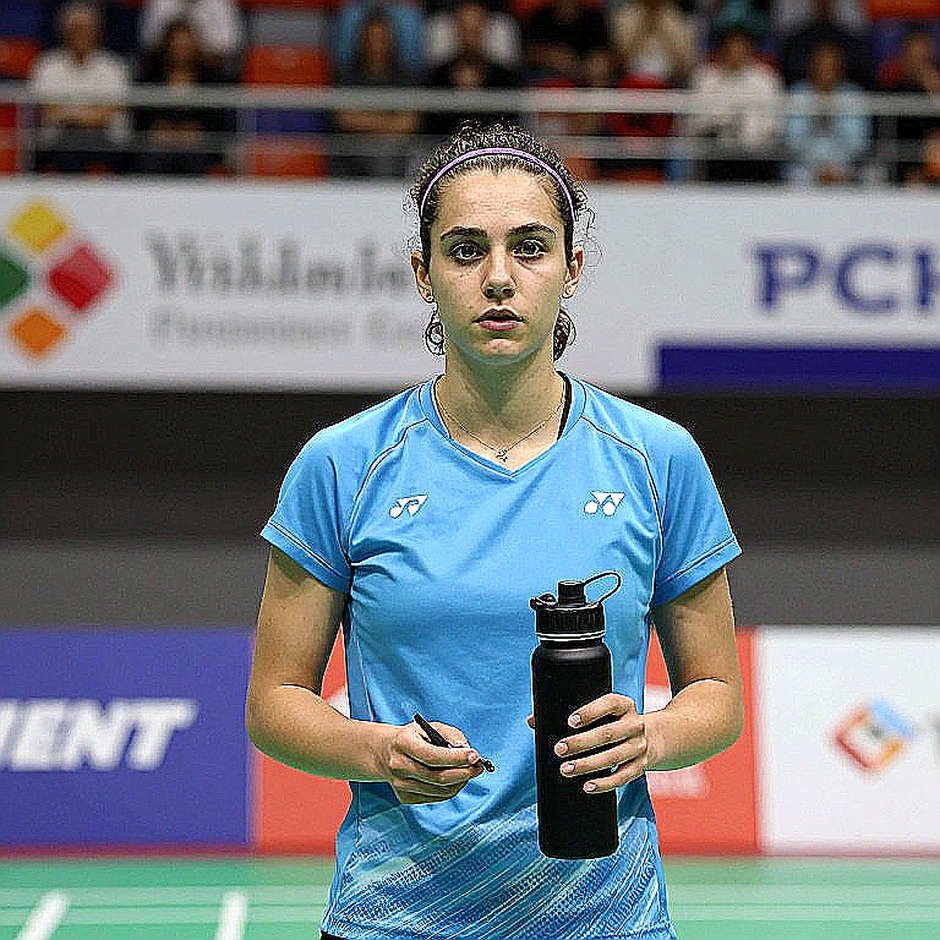
Sport is organised as an industrial system, not as a talent contest. Danes do not wait for genius. They build a track, and they place genius on it.
I have spent years comparing this system with Asian models. The differences lie in three places.
First, club infrastructure. Denmark has a dense network of badminton clubs covering small towns. A seven-year-old in Ikast or Silkeborg can walk to a nearby club, three sessions a week, at a cost most middle-class families can afford. In many Asian countries, the road to elite badminton runs through specialised sports schools with harsh training from a very early age. Denmark takes the opposite path: keep children playing as long as possible, and separate only the very best in late adolescence.
Second, coaching philosophy. Danish players are famous for their physical base and height. Axelsen is 1.94 m; Antonsen 1.83 m; Peter Gade 1.83 m. But height is a condition, not a solution. What makes the difference is the ability to convert physical advantage into spatial advantage — how a tall player can still move fast enough to cover both corners.
I remember a video session I witnessed at Brøndby. They replayed Axelsen at the All England and froze every footstep. They counted his steps from the centre to the front left corner, then to the back right. The numbers were recorded: seven steps for a diagonal, five for a straight line. Then they played a similarly tall Asian player and counted again. Six steps. Four steps.
One step, in a single rally. Multiply by sixty rallies. Multiply by three games. That is how Danes talk about badminton — not with inspiration, but with footstep counts.
Third, and this is the point I consider most important, a culture of tolerating boredom. Elite badminton is not a string of spectacular rallies. It is a string of identical rallies, repeated until one player errs. Danes have a training word for it: tålmodighed — patience. They do drills I once heard an Asian coach call meaningless: hitting shuttles back and forth at a fixed angle for thirty minutes.
The result of that culture is a distinctive playing style. Technically, elite Danish players usually have four traits. First, a stable low serve, few variations but a very low error rate. Second, defensive ability through a deep lift, pushing the opponent to the back. Third, a powerful straight smash used sparingly. And fourth, a drop shot I have always felt is their secret weapon.
In the Paris 2026 final, Axelsen beat Kunlavut Vitidsarn to take his second gold. Looking back, what stands out is not the smashes but his win rate in long rallies. When a rally passed twenty touches, Axelsen was almost always the one to close it. That is not power. That is patience trained over decades.
Based on my experience watching matches across more than four decades, this is the fundamental difference between European and Asian badminton. Asian players are often better in short rallies and decisive shots. Danish players are better in long rallies and in maintaining structure. In a three-game match lasting over an hour, structure usually wins.
One technical detail deserves a pause. In modern badminton, the serve has become a tactical weapon. In men's singles, most players use a low serve or a high serve depending on the opponent. Danish players tend to use the low serve at a higher than average rate, because they trust their defence. It is a calculated choice: a low serve removes the risk of an immediate smash but hands tempo control to the opponent.
By contrast, many Asian players — especially Indonesians and Malaysians — prefer the high serve to open an attacking rally. It is a philosophical difference: defend first or attack first. And over the past fifteen years, the global trend has tilted steadily towards attack.
Beyond men's singles, Denmark has a formidable doubles tradition. Mathias Boe and Carsten Mogensen were once the world's number one men's pair, winning silver at London 2026. Kamilla Rytter Juhl and Christinna Pedersen took silver at Rio 2026 in women's doubles. Joachim Fischer Nielsen and Christinna Pedersen topped the world in mixed doubles.
What do these pairs share? Stability. They were not the most individually brilliant, but they made the fewest errors at the decisive moments. In doubles, where rally speed is double that of singles, a player's value lies not in what he creates, but in what he does not lose.
But there is a gap. And that gap is women's singles.
Denmark has never produced a world or Olympic champion in women's singles. While Asia keeps producing players like Tai Tzu-ying of Taiwan, Chen Yufei of China and An Se-young of South Korea, Denmark has struggled. Mia Blichfeldt, Line Kjærsfeldt — good names, but never at the very top.
This is a paradox I have thought about a great deal. A nation with Europe's best development system cannot produce a world-class women's singles player. The answer, I believe, lies in incentive structure. In Denmark, men's badminton has a clear role model and a career path — you can make a living, you can become famous, you can become Axelsen. In the women's game, that model is dimmer. And when the model is dim, talent flows to other sports — handball, athletics, or swimming.
The Denmark Open, held annually in Odense, is one of the oldest tournaments in world badminton, with a history dating to 2026. For decades it was the spiritual home of Danish badminton — where local fans could see their stars compete. But in recent years, the Odense stands have grown emptier of Danish players in the finals. It is a small signal, but a persistent one.
But now I must say something that will likely displease many Danes.
For more than a decade, the Danish model has been praised as a template. Sports conferences in Asia invite Danish experts to lecture on the sustainable development path. Articles praise the balance between sport and education, the humanity of a system that does not burn children's childhoods.
I once believed it. Now I am not so sure.
Problem one: the Danish model succeeds because it is small, not because it is right. With six million people and a culture that values grassroots sport, Denmark can sustain a system built on balance. But that system cannot be replicated. Apply it to a country of hundreds of millions with a centralised sports system, and you get something entirely different — as in China, where the sports-school model remains the backbone.
Problem two: dependence on individual genius. Axelsen and Antonsen are not average products of the system. They are lucky exceptions. Remove Axelsen from the equation and Danish badminton's results over the past decade fall sharply. That is a systemic risk: a nation whose performance rests on two individuals now entering the twilight of their careers.
Axelsen was born in 2026. He is thirty-one. Antonsen was born in 2026, twenty-eight. In badminton, a singles player's peak usually runs from twenty-three to twenty-nine. Both are at or past it. And behind them, the talent gap is widening.
Problem three: the silence around injuries. Over years of following badminton, I have noticed a pattern. When a Danish player withdraws from a tournament citing personal reasons or a minor injury, information is often vague. The federation and medical staff tend to disclose little. And I understand why: in a sport where sponsors and broadcast deals depend on star presence, announcing a serious injury can dent commercial value.
But from a fan's perspective, that is unfair. You pay for a ticket to see Axelsen, and he withdraws. You are not told the real reason. In a sport where fans are ultimately the paymasters, transparency is not a privilege — it is an obligation.
I remember 2026, when I hosted broadcasts of the Sudirman Cup and the Table Tennis World Cup. I learned a lesson I have carried ever since: behind every medal is a system, and behind every system are people who can be hurt in ways the media rarely reports.
Problem four, and perhaps the gravest: Asian investment is pulling away from Denmark. While China, Japan, South Korea and, more recently, India pour tens of millions of dollars into infrastructure, sports science and data analytics, Badminton Denmark's budget remains modest. The technology race — from player-tracking sensors to AI video analysis — is being led by Asian centres.
I know I can be wrong. I have been wrong many times. In 2026 I predicted Morocco would reach the World Cup semi-finals and was right, but at the same moment I completely missed Cristiano Ronaldo's move to Al Nassr because I was absorbed in another debate. That lesson stays with me: one can be right where it is loud and wrong where it is quiet.
That is why I speak of ashes. The simulation dream has melted away, but ashes can still write legend. The Danish model may be entering its hardest phase, yet it is precisely in that phase that its lessons become more valuable than ever.
So which way should we look?
The answer, I think, is not to copy the Danish or the Asian model. It is to understand that every system is an answer to a specific question. Denmark answers: how can a small nation hold its place in a global sport? Asia answers: how can a centralised system maximise medal counts?
Both are right, and both carry a price.
What I am certain of is this: the era of lone individuals carrying a sport is closing. Axelsen and Antonsen are the last of a generation. What comes after them will be decided by data, by science, and by doors someone must be brave enough to knock on.
Meta can go on cooldown, but storytelling never runs out of mana. Each generation of players passes through, leaving a new sediment for those who follow to read again. And in badminton, that sediment is thicker than we think.
There are doors that are not locked, only no one has knocked. In badminton, that door may be in a small club in Jutland, at a six a.m. session, where a twelve-year-old is hitting shuttles against a wall. No crowd. No camera. Only the sound of shuttle on racket, repeated, until it becomes instinct.
I am 59, and I still believe in the magic of the map. Because the map of world badminton is redrawn every season, and every time it is redrawn, a new boundary appears somewhere no one expected.